GenAI Enablement and Adoption for Enterprises: What Actually Works in 2026
Real-world GenAI adoption: skills, workflows, metrics, and change programs that deliver

I’m Siddhesh, a Microsoft Certified Trainer, cloud architect, and AI practitioner focused on helping developers and organizations adopt AI effectively. As a Pluralsight instructor and speaker, I design and deliver hands-on AI enablement programs covering Generative AI, Agentic AI, Azure AI, and modern cloud architectures.
With a strong foundation in Microsoft .NET and Azure, my work today centers on building real-world AI solutions, agentic workflows, and developer productivity using AI-assisted tools. I share practical insights through workshops, conference talks, online courses, blogs, newsletters, and YouTube—bridging the gap between AI concepts and production-ready implementations.
If you lead engineering, learning, or transformation at a large enterprise, you have probably noticed something uncomfortable. Your teams have access to ChatGPT, Copilot, Claude, maybe Cursor or Windsurf. Licenses are paid. Announcements went out. And yet, when you look at pull requests, support tickets, or proposal documents, very little has changed.
You are not alone. Most enterprises I work with are stuck somewhere between "we bought the tools" and "our people use them well." That gap is where real money sits, both in cost saved and revenue created. This post is about how to close it, written from two decades of architect, consultant and trainer work, including recent GenAI enablement programs at ADP and partner sessions on the Microsoft AI Tour.
Here is what we will cover:
Where most enterprises actually stand on GenAI adoption today, beyond the press releases
The specific reasons tools like Copilot, Claude and Cursor stall after rollout
The real financial and competitive cost of that stall, with numbers you can defend in a board meeting
A practical six-layer enablement model that has worked across banking, payroll, EdTech and public sector
How to start small with a two-week assessment and a measurable pilot
Where Most Enterprises Actually Are
Let me describe what I keep seeing across banking, payroll, manufacturing, EdTech and public sector clients.
A central team has rolled out GitHub Copilot, Microsoft 365 Copilot, or an internal wrapper around Azure OpenAI / Foundry.
A "GenAI Center of Excellence" exists on paper, usually owned by either the CTO office or HR L&D.
A few enthusiastic engineers are doing impressive things in isolation, often on personal time.
Compliance, security and legal have written a policy document that nobody outside their team has read.
Leadership has committed to a board-level KPI such as "30 percent productivity uplift" without a baseline to measure against.
The tools are present. The intent is real. The adoption curve is flat.
This is not anecdote. McKinsey's most recent global survey on the state of AI shows that while GenAI usage has roughly doubled in a year, only a small minority of organisations report material EBIT impact from it, and most are still confined to one or two business functions.
Generative AI adoption and bottom-line impact by function — McKinsey, The state of AI
The pattern is consistent: high usage, low impact. That delta is the enablement gap.
Why Tools Alone Do Not Move the Needle
Buying licenses is the easy part. The hard part is everything around the tool. Here is what typically goes wrong, in the order I usually uncover it during an assessment.
1. Generic training that ignores the day job
Most vendor-led training is a one-hour webinar showing the same five demos: summarise a document, draft an email, write a Python function, generate a SQL query, create an image. None of that maps to what a claims adjuster, a payroll consultant, or a SAP ABAP developer actually does on Tuesday morning.
People watch the demo, nod, return to work, and forget. The drop-off is brutal. Without role-specific scenarios, retention after two weeks is close to zero.
2. No prompt or workflow library tied to real artefacts
Enterprises rarely capture and share the prompts and agent workflows that actually worked. Every developer reinvents the wheel. Worse, the prompts that get shared informally on Teams are often the weakest ones, because the best practitioners do not have time to write them up.
3. Security and IP fear, mostly unaddressed
"Can I paste customer data into this?" is the single most common question in every workshop I run. If your enablement program does not answer it clearly, in writing, with examples, your people will either over-share (risk) or under-use (waste). Both are expensive.
4. Confusion between Copilot, Agents, and Workflows
I see senior architects use these terms interchangeably. They are not the same. A code-completion Copilot, a chat assistant grounded in SharePoint, and an autonomous agent that files a Jira ticket and updates a Cosmos DB record are three very different beasts with three very different governance needs. Treating them as one bucket leads to either paralysis or recklessness.
5. No measurement strategy
If you cannot answer "what was our cycle time, defect rate, or handle time before Copilot," you cannot prove value after. Most programs I audit have no baseline. The board asks for ROI in month nine and the team scrambles to back-fit numbers.

What This Costs You
Now let me push on this, because the cost is usually larger than leadership realizes.
Direct license waste. A typical enterprise Copilot seat runs roughly 19 to 39 USD per user per month depending on SKU. If only 20 percent of seats are used meaningfully, you are burning 80 percent of that budget. For a 5,000 seat rollout, that is well over a million USD a year of pure waste.
Opportunity cost on engineering throughput. Independent studies and the data I have seen on the ground suggest that well-trained developers using Copilot, Cursor or Windsurf complete coding tasks 25 to 55 percent faster on specific task types. If your developers are at the lower end of that range because they were never taught how to write good context, how to use agent mode, or how to chain tools, you are leaving roughly 8 to 12 hours per developer per month on the table. Multiply by your headcount and fully loaded cost. The number is uncomfortable.
Shadow AI risk. When official tools feel clunky or unclear, people use personal accounts. That is where your customer data, source code and proposal drafts leak. The fines and reputational damage from a single incident dwarf the cost of a proper enablement program.
Slower competitive response. Your competitors who have cracked enablement are shipping features, proposals and customer responses noticeably faster. In sectors like fintech, EdTech and SaaS, the gap compounds quarter over quarter.
Talent flight. Strong engineers want to work somewhere they can use modern tooling well. If your environment feels stuck in 2022, your best people will quietly move.
The productivity numbers above are not marketing. They come from peer-reviewed and large-sample field studies:
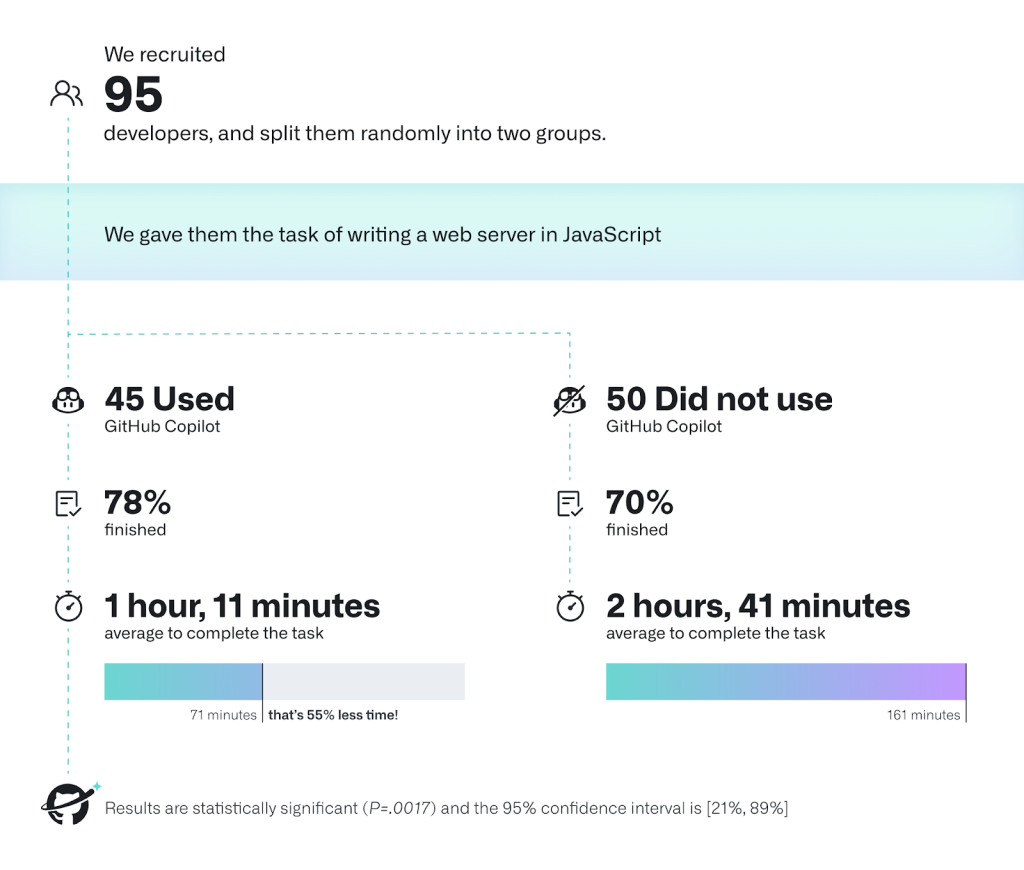
Chart: Summary of the GitHub Copilot controlled experiment — 95 professional developers, randomised. Source: GitHub Research, "Quantifying GitHub Copilot's impact on developer productivity and happiness".
Two further references worth reading in full:
Study: Generative AI at Work — Brynjolfsson, Li, Raymond, NBER Working Paper 31161. Customer support agents using a GenAI assistant resolved 14 percent more issues per hour on average, with a 34 percent jump for novice and low-skilled workers.
Study: Navigating the Jagged Technological Frontier — Harvard Business School / BCG. Consultants with GPT-4 access completed 12 percent more tasks, 25 percent faster, with 40 percent higher quality on tasks inside the AI's frontier.
What a Working Enablement Program Looks Like
Here is the model I have refined across forward-deployed engineer programs and consulting engagements. It is not theoretical. Each layer has been used in production with real teams.
Layer 1: Persona-based skill mapping
Start by mapping every role that touches the tool to three things: their top five recurring tasks, the artefacts they produce, and the tools they already live in. A backend developer in your payments team and a customer-success manager in your SaaS division need completely different curricula even if both have "Copilot" in their license.
Layer 2: Role-specific labs with your own data
Forget generic Python demos. Build labs that use sanitised versions of your own codebases, your own policy documents, your own ticket formats. The "aha" moment happens when someone refactors a function from their actual repository, not a toy example.
Layer 3: A living prompt and agent library
Treat prompts and agent definitions as first-class engineering artefacts. Version them in Git. Review them in pull requests. Tag them by role, task and tool. This is where Microsoft Foundry, GitHub Copilot custom instructions, Claude projects and Cursor rules become powerful, because they let you encode institutional knowledge into the tool itself.
Layer 4: Clear, written guardrails
A one-page "what you can and cannot paste" guide, signed off by legal and security, beats a fifty-page policy nobody reads. Pair it with a sanctioned path for sensitive workloads, usually a private Azure OpenAI or Foundry deployment with logging.
Layer 5: Measurement that survives a board meeting
Baseline before you train. Track DORA metrics for engineering, handle-time and CSAT for support, cycle-time and win-rate for sales. Tie the GenAI program to the same numbers the business already cares about. Avoid vanity metrics like "prompts per user."
Layer 6: Community and reinforcement
A weekly thirty-minute internal show-and-tell, a Teams or Slack channel where people post wins, and a small group of "champions" with explicit time allocated to help peers. This is the cheapest and most under-used part of every program.

Why I Am Positioned to Help You Do This
I do not write this as a pure observer. Most of my last few years have been spent inside enterprises doing exactly this work. A short, honest summary:
Two decades as Architect, Consultant and Trainer across IT, Cloud and Generative AI. I have been on both sides of the table, building systems and teaching the people who use them.
Microsoft Certified Trainer and Pluralsight Instructor, so the pedagogy is structured, not improvised.
GenAI enablement and adoption consulting for ADP, a global payroll and HCM leader. Real enterprise constraints, real compliance, real outcomes.
Forward Deployed Engineer programs, embedding with customer teams to ship, not just to advise.
Hands-on with the full modern stack that enterprises actually use: Azure, Microsoft Foundry, GitHub Copilot, Microsoft 365 Copilot, Claude, Cursor, Windsurf, plus the .NET, Java, MEAN and MERN ecosystems your existing applications are built on.
Earlier work that informs how I think about scale and reliability: part of the original team for the Repository platform at Microsoft that later became Entity Framework, Letter of Credit work at BNY Mellon, support for the UK schools system SIMS at Capita, HMI work for Sperry Marine / Northrop Grumman, and monitoring products for IBM including onsite delivery in Italy.
Public contribution: published research papers, the Transformer Visualizer for teaching attention intuitively, a VS Code extension for Amazon Q log analysis, and open-source work on GitHub.
Recent speaking includes the Microsoft AI Tour for Partners, Mumbai, December 2025, Azure Back to School 2025, and the Global Power Platform and Agent Bootcamp, Pune 2026.
What this means in practice: when I walk into your environment, I can speak the language of your developers, your architects, your security team and your CFO in the same week. That cross-fluency is what enterprise GenAI adoption actually needs.
A Practical Starting Point
If any of the situation above sounds familiar, here is a low-risk way to move.
Two-week assessment. I sit with three to five representative teams, review your current rollout, your tools, your policies and your metrics, and deliver a written gap analysis with a sequenced roadmap.
Pilot enablement wave. One or two cohorts of 20 to 40 people each, role-specific labs, measurable outcomes within six to eight weeks.
Scale and govern. Champion network, prompt and agent library in your repos, measurement dashboard tied to existing business KPIs.
You do not need to commit to a year-long program to find out whether this works for your organisation. You need one honest assessment and one well-run pilot.
If You Want to Talk
Book a 1:1 session on Topmate for a focused conversation about your specific situation.
Connect on LinkedIn if you prefer to start there.
Browse code and projects on GitHub.
Subscribe to the Cloud Authority newsletter and the Azure Authority blog for ongoing notes on GenAI, Azure, Foundry and modern engineering.
GenAI adoption is not a tooling problem. It is an enablement, governance and measurement problem wearing a tooling costume. The enterprises that understand this in 2026 will be unrecognisably more productive by 2027. The ones that do not will keep paying for licenses that sit idle.
If you want help making sure you are in the first group, you know where to find me.